Psalms 106:1-18 * 106:19-48; 2 Kings 21:1-18; 1 Cor 10:14-11:1; Matthew 18:28-34A place for reflections on the Daily Office (and occasionally other things)
Monday, October 3, 2011
Daily Office Reflection: Listening
Psalms 106:1-18 * 106:19-48; 2 Kings 21:1-18; 1 Cor 10:14-11:1; Matthew 18:28-34Sunday, October 2, 2011
Pentecost 16 A

Preached @ St. Christopher’s, Roseville, MN 10/2/11 Matthew 21:33-46
| I |
need to tell all of you something very personal. I need to “come out” so to speak. This is something about with I am quite proud and is a part of who I am, as a person, as a priest, as the rector here at St. Christopher’s. I’m …..a tither. Yes, I tithe. I give 10% of my financial blessings to God, and I get to keep 90%. In fact I have filled out the card with my pledge to St. Christopher’s reflecting this tithe, and will be joining your Vestry today when we present our pledge cards at the Altar.
When I joined The Episcopal Church, I had no idea what tithing meant, what it was, where it came from, or how this seemingly impossible concept would change my life. I know when I first started attending an Episcopal Church I would have found it helpful to have had explained to me what tithing was: the physical mechanics of it. Now, talking about money can make us feel uncomfortable. We need to get over that feeling and move on. We need to talk about it.
There are many definitions of what tithing means. Some say it is 10% of our gross income. Period. The end. But being Episcopalian, we know that very little in life is so black and white. Another definition of tithing is to work off of our net income (after taxes). Some work off of a figure derived from “non-spoken for” money: i/o/w after taxes are taken out, after fixed expenses are paid, like the mortgage, and from that figure we are to take 10% and give it to God’s church. I used to follow this latter approach, the after taxes and mortgage approach. For this pledge card, I looked at my pay stub, looked at the number that said “net pay”, multiplied that number by 24 (we get paid twice a month, so there are 24 of those pay stubs) and that figure I multiplied by 10%. The resulting figure is my yearly tithe to St. Christopher’s. I then divided that yearly tithe by 52 (for the number of weeks in the year) and found my weekly contribution to this place. Simple, direct….. and freeing.
How does this tithing “stuff” have anything to do with our Scripture readings today? As our Collect begins today, we acknowledge that God gives us more than we can either desire or deserve. God’s generosity is beyond our understanding. We acknowledge that generosity in our Collect today and we see that generosity made manifest in the parable Jesus tells in our Gospel from Matthew.
Not only do we see God’s generosity, but we see God’s trust and God’s patience with us in this parable. The landowner in our parable is God. And this landowner keeps giving and giving. This landowner keeps reaching out and offering help and assistance. And then God sends the Son, the only Son: this Son who represents the future. God is willing to give this only Son for the future. What are we willing to give for our future?
At the end of the parable, Jesus explains that God will move on if we do not grasp the future given to us, if we do not produce the fruits of the kingdom. Another translation of this verse is that God will hand over these opportunities “to a people who will live out a kingdom life.” Living out a kingdom life is what we are called upon today in this Gospel passage….a key part of that kingdom life is working for, offering ourselves for the future: offering ourselves, our talent and treasure, for the future. Talent, treasure……tithing…..all tied together.
We need to be clear, talent, the offering of our non-financial gifts is a critical piece of what we are called upon to do as members of the Body of Christ. The talent we offer, and which St. Christopher’s is so very blessed to be the recipient of in abundance, is not a substitute for the financial tithe about which we are speaking today. That financial tithe of 10%, however you define this amount, is a critical piece of securing St. Christopher’s future, securing this piece of the Kingdom, assisting in its growth and prosperity, its rejuvenation.
This financial tithe is a spiritual exercise, a spiritual discipline. I promise you, by tithing you will be changed at a profound level. The relationship with St. Christopher’s will grow deeper in a manner that will be surprising. The way that you feel about yourself, no matter the dollar amount of this tithe, will inextricably be altered. Tithers know this. They know the difficulty, the challenge, the reward. Tithers don’t often talk about it, for who talks about money in polite society…. but we should…..10% for God, 90% for us. 90% we get to keep! Granted, 10% is a lot to ask. But this 10% is not only a sign of commitment to this place, but more importantly it is living into a relationship with God, acknowledging God’s generosity to us, and making manifest our own generosity in response to all that God has gifted to us.
No amount is too large, no amount is too small. I am asking that every single person, or family unit, pledge this year. I am asking for a 100% response representing every member of this Church. I am asking this of you as your new rector, and as a sign of gratefulness for the search and discovery committees work in finding me, and in thanksgiving for the Vestry’s calling me here. I ask that you increase your pledge and tithe when you fill out this year’s pledge form.
Know that at our last Vestry meeting, I told the Vestry that I will tithe. Know that I asked…. well I more than asked, I told them I expected them to tithe as leaders of this church, or at the very least increase their pledge to be on the road to tithing in the next couple of years. What I asked of them, I now ask of you….. For what are we willing to sacrifice for our future? For what are we willing to give to make manifest the Kingdom life? I ask that you commit to the spiritual discipline of tithing to St. Christopher’s this year when you complete your pledge card.
jfd+
Copyright 2011, The Rev. John F. Dwyer. All Rights Reserved.
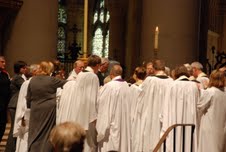
Photo: Celebrating, 2011, jfd+
Saturday, October 1, 2011
Daily Office Reflection: Both And

Psalms 107:33-43, 108:1-6(7-13) * 33; 2 Kings 19:21-36; 1 Cor 10:1-13; Matthew 8:18-27Friday, September 30, 2011
Daily Office Reflection: Healings
Thursday, September 29, 2011
Daily Office Reflection: St Michael & All Angels
MP: Psalms 8, 148; Job 38:1-7; Hebrews 1:1-14Friday, September 23, 2011
Daily Office Reflection: The Lord's Prayer
Psalms 88 * 91, 92; 2 Kings 9:17-37; 1 Corinthians 7:1-9; Matthew 6:7-15Wednesday, September 21, 2011
Daily Office Reflection: St Matthew
MP: Psalm 119:41-64; Isaiah 8:11-20; Romans 10:1-15Monday, September 19, 2011
Pentecost 14 A

Preached @ St. Christopher’s Ep. Ch., Roseville, MN, 9/18/11, Matthew 20:1-16
| W |
e have a provocative Gospel reading today. One that shakes up many of our understandings of fairness and justice and one that does not provide us with any easy answers. This parable Jesus tells, of who we might name as the unfair landowner, does not tell us what to do. This parable leaves us hanging, with tension in the air, over….what it means to be a disciple of Jesus.
This parable may prove offensive to many of us because it challenges our understanding of fairness. What comes just prior to this selection can provide a deeper and richer understanding of Jesus’ message, but does not lessen the sting of this parable. Jesus has finished having a conversation with “the rich young man” whom he challenges at the end to sell all his possessions and give them to the poor and then follow him. That young individual goes away crest fallen and Jesus than has a conversation with Peter who asks Jesus, well then who can get into the kingdom of heaven? Jesus’ first response is to tell Peter that their reward will be great because they have left home and hearth and everything to follow him. But then Jesus tells Peter and the disciples this parable of what the kingdom of heaven is like. (Jesus gives and then he twists what he has given to make us look at the world differently.)
Notice, the kingdom of heaven is like this landowner. Jesus is not saying that God is the landowner. Jesus is saying something quite different: the kingdom of heaven is like unto this landowner. Jesus has just told Peter and the disciples that their reward will be great in heaven and then tells the parable we hear today that changes and challenges and reverses all our known values about fairness and justice. What is he doing here?Truly, this difficult parable is about resentment we feel at others who have received the same grace we have been gifted to receive. This is a difficult value system in which to live….Nevertheless, it is ours.
We have heard similar parables by Jesus: think about the prodigal son and the father’s joy upon his return, and the elder brothers resentment…..there are very close similarities to our parable today. Obviously, there is an important message we are supposed to take away from these challenging stories Jesus keeps airing. The Hebrew scholar C. G. Montefiore refers to this parable of the landowner and his hiring practices as “one of the greatest and most glorious of all.” He said this because he believed the parable contains very deep truths about God and God’s relationship with all of us.
If we study this parable closely we see that this landowner is going out into the market place area to hire people standing around. In the time and place that Jesus would have been telling this parable, the market place was the area for those who were unemployed to bring the tools of their trades and wait to be called upon to work. This scene is evocative of what I have seen out on the East Coast. Being new to this area of the world, I do not know if the same happens here. At Home Depots and similar-type stores, Latinos gather and stand around in the HD parking lots, waiting to be hired by contractors and homeowners. (Sound similar?) Toward the end of the day, the ones who have not been blessed with a wave of the hand to jump in the back of some contractor’s truck and do some work are pretty desperate and start approaching anyone getting out of a car asking if help is needed.
That market place scene in our Gospel, and as made more relevant today by the Home Depot parking lot market place, highlight one of the take-aways from today’s parable, which can be thought of as God’s compassion. Jesus is talking about the basic and natural right for everyone to work. The basic and natural right that everyone should be paid for that work, and is highlighting the tragedy of unemployment.
From those highlights, those natural rights, Jesus is leading us to understand that there are no special honors for those of us who come in first, for those of us who excel. Coming in first, excelling are reward unto themselves, and they go no further. They are, to use the words from our Collect today, earthly things that pass away. They are not things that are heavenly because they do not endure and we should not hold them fast. (Heidi Klum and Project Runway: “One day you’re in, and the next day, you’re out.)
This is a very different value system Jesus is setting out in this rough parable. We cannot be envious or jealous or made to be angry by this parable, as natural as those responses probably are for us. We are not to work for the reward, Jesus is saying, but work for the joy of doing God’s work in serving others. That joy in doing that work can bring an understanding of God’s grace….that grace is always surprising and is always unexpected. All of these parables tell us that. (Pause)
We can become so easily disillusioned if we are working for rewards sought and focusing on what others receive, as seen in those workers who were hired first in the parable. If we look closely at this Gospel passage, we will find that the last workers weren’t promised any pay, while all the groups before had been promised to be treated fairly. The last group just went to work, glad for the opportunity, the chance to work. Perhaps this parable is instructing us to go out like that landlord and find workers to help establish the kingdom of heaven amongst us. Perhaps this parable is reminding us that working to establish the kingdom is the reward in its own right and we should expect nothing else. Perhaps this parable is asking us to go out into the world and invite people to come be workers here at St. Christopher’s: workers of the kingdom of heaven, creating that kingdom by our work and those invitations for others to join.
In this very strange kingdom of heaven our parable describes, everyone matters: even the powerless, those with seemingly few skills and those who seem to get in our way. Children matter in this kingdom. Adults of all shapes, sizes and skillsets matter in this kingdom of heaven. The poor matter in this kingdom of heaven. Everyone….every single person matters.
And God’s equal treatment of all people can plain and simply make us angry: “We’re smart and wealthy and talented and skilled and been at this for decades, why should “they” be treated the same as me?” This equal-grace-of-God can be greatly distressing…..Specialized skillsets and hard work absolutely matter. But Jesus is saying they do not matter more than the humanity and dignity of every human being. Jesus is showcasing God’s abundance, God’s abundant love….there is no scarcity here….There is no scarcity in the kingdom of Heaven.
We can see why Jesus was so very unpopular, for he treated everyone as worthy, everyone as equal. He sought out those who, by society’s standards, were not equal. Jesus played no favorites….everyone is equal….Who in our community do we treat as less than equal to us? Who can we help out of the tragedy of unemployment and mimic this landlord in creating the kingdom of heaven? Who do we need to reach out to, and ensure they know that they matter….to us….and to God? Amen.
jfd+
Copyright 2011, The Rev. John F. Dwyer. All Rights Reserved.
Photo: Laying on of hands, 2007.
Saturday, September 17, 2011
Daily Office Reflection: Do and Teach
Friday, September 16, 2011
Daily Office Reflection: Saltiness and Lightness
Monday, September 12, 2011
Daily Office Reflection: Temptations and Exhaustion
Psalms 56, 57 (58) * 64, 65; 1 Kings 21:1-16; 1 Cor 1:1-19; Matthew 4:1-11Sunday, September 11, 2011
Pentecost 13 A - September 11, 2011
Preached @ St. Christopher’s E.C., Roseville, MN, 9/11/11, Matt 18:21-35
Ten years ago today was a beautiful Tuesday morning in New York City. I had gotten up at my usual early time, walked the dogs, gone to the gym, said Morning Prayer, had a quick breakfast and had left home a bit earlier than usual so I could go vote in the primary elections that were taking place that day. I arrived at work in downtown Manhattan at the usual time, approximately 7:45 AM or so. I was sitting in my office, doing I don’t know what, when I noticed something floating down past my windows. Looking, I saw it was bits of paper, and I thought “It’s too early for a ticker tape parade up Broadway.” Being a bit confused I looked again and noticed that most of the papers were either burning, or singed. Logging onto CNN on my computer I learned that the newscasters were surmising a small plane had struck the north tower of the WTC. I remember them showing a picture of a sizeable hole in the north side of that north tower. A very short while later, my staff and I heard the roar of the second plane and the crash and thunderous noise it made when it struck the south tower. We not only heard, but could actually feel the impact in our office. We were two blocks away and on the tenth floor of an office tower. Looking down at the street, we could see people running, hordes and hordes of people running: it reminded me of one of those bad Asian horror films of people running in the streets trying to escape the terrors of whatever beast was chasing them. |
That was the beginning of a long morning where each moment will be forever etched in my memory. It is one of those times in life that has not faded, and probably won’t fade: one that I can call up details, as if it were yesterday and not ten years ago, today…..And by the working of the Holy Spirit we are provided a Gospel passage that may prove challenging for many of us….How do we forgive the trauma, loss and horrors of that day?.....How do we forgive?
Our Gospel selection for today is challenging and can be easily misinterpreted. Peter is once again given the role of foil to Jesus’ wisdom when he begins our passage today by asking Jesus how many times we must forgive, seven? Peter was being clever here, because the ancient and historic rabbinic teachings instructed to forgive three times: Peter more than doubled that teaching. And Jesus says no, not seven but 77, and then he launches into the story of the king and the slaves
This story of the king who forgives the slave a debt of 10,000 talents and that same slave’s inability to forgive a debt of 100 denari is one that needs some explanation in order to bring understanding and relevance to our ears. 1 talent was roughly equivalent to 15 years’ wages for the average worker. So this king’s forgiveness would equate to 150,000 years’ worth of wages being forgiven. That is quite a debt for the king to forgive this slave. 1 denari was roughly equivalent to 1 days’ wage. So this no longer indebted slave refused to forgive 100 days of wages. 100 days vs. 150,000 years worth of wages is the unbalanced scale the first hearers of this Gospel would have understood upon hearing Jesus tell this story…
Who does the king represent? God? Or us? If it is God, this makes the end of the story troublesome, because that forgiving king turns vicious when he learns of the forgiven slave’s actions, and that viciousness seems to run counter to the point at which Jesus is driving. But if the king is representative of us, all of us, then the king’s actions bring to light something different. The story illustrates and instructs us to pay heed to the importance of having a forgiving nature, a forgiving heart. The story also highlights how bad the lack of forgiveness truly can be, for us and for those for whom we refuse to grant forgiveness. This story is telling us to not be like the forgiven servant, but also to not imitate the king’s anger, for the king never really forgave the servant. We cannot forgive someone and retain resentment in our hearts….that lingering suspicion and dislike can so poison our relationships with one another.
Jesus is doing something remarkable today and something not at all popular in the culture of our nation. Jesus is pointing us away from revenge, away from resentment and the holding of grudges and toward a forgiving nature: which is the nature of God. Jesus is pointing us to have an unlimited forgiving nature, which is the nature of God. Today’s Gospel gives us a seemingly impossible challenge: to emulate God in this forgiving nature.
How can we effectuate that kind of attitude and mindset today? How does this forgiving nature we are called to embody have any relevance to us here at St. Christopher’s this September 11th…..this tenth anniversary of those terrorist attacks? How does this have anything to do with St. Christopher’s opening day festivities, this first day of our program year…..this first Sunday of your new rector’s tenure?
Over the past ten years, this anniversary has become to me like a funeral. For something important was lost that day ten years ago, and I’m not referring to the thousands of lives taken from us that morning. And funerals, in most people’s psyche’s and understandings can be sad, morose occasions. But in our Episcopal lives, we know that funerals are actually celebrations. The rubric found on page 507 of our BCP says (in part): The liturgy for the dead is an Easter liturgy. It finds all its meaning in the resurrection….The liturgy, therefore is characterized by joy….This joy, however, does not make human grief unchristian. The very love we have for each other in Christ brings deep sorrow when we are parted by death….So, while we rejoice that one we love has entered into the nearer presence or our Lord, we sorrow in sympathy with those who mourn. That statement provides a guideline for the richness and complexity that this anniversary can be for us, and can and does provide guidance in regard to this forgiving nature we are called to embody.
A question that always arises is, How is any of this fair? This idea of fairness is not the right focus because God’s love is basically unfair by our standards…..for it is for everyone, available to everyone. And it is from that basic, life-altering place, that we can begin to live into and embody a forgiving nature as a rooted-center to how we approach and interact in the world. Think about the talents and denari imbalance and the unfairness of the nature espoused by the servant character. St. Augustine opined that Jesus is referring to an unlimited amount of forgiveness by his choice of the number 77. Augustine pointed to the genealogy of Jesus in Luke; there being 77 generations listed going back to the creation stories. Augustine’s belief was that Matthew picked this number so as to prove the point that all generations have been forgiven through Jesus.
We are instructed by Jesus today to live into the unbalanced nature of forgiveness. We are to fall on the side of the 150,000 years, not the 100 days….we are to strive to forgive all the way back through every generation, not just three or seven times. This is an astounding thing to be asked to do.
Throughout all of scripture we find imbalance and unfairness, as we define those principles…. God’s definitions are far different. What we are called to today is an acknowledgement that God’s forgiveness, God’s forgiving nature outstrips every act we are called upon to forgive. An acceptance of that principle can allow us to upend our tangled-selves and straighten into a forgiving nature that controls who and what we are as a people and control how we operate in the world.…..Not at all easy…In particular when we are immersed in a national day of remembrance for acts that seem unforgiveable. But for God, and as demonstrated by Jesus today, nothing is unforgiveable. For us? The simple truth is we have our marching orders today….to approach the world with God’s forgiving nature imbuing all that we do.
The crashing discordance that may seem to be this anniversary of 9/11, the joyous celebration of the beginning of St. Christopher’s program year, and the grateful acknowledgment that a new rector has appeared here at St. Christopher’s, are really not disharmonious. Similar to the celebratory nature of a funeral, today can and does embody the richness that is our lives as the Body of Christ in the world today. There is the deep sadness and confusion of what occurred ten years ago, mixed with the joy of new life, a new year with new leadership. Anxiety and joy mixed together, as they always are in life. All rooted in love: love of this holy place, love of each other, love of God and God’s love for us…. and the knowledge of resurrection moments all around us. Jesus is showcasing for us in this story of the king and slaves that forgiveness brings about resurrection moments in our lives. And from that place of love and joy and excitement and unsettledness, we can find the strength to forgive, embody a forgiving nature that is transformative to each of us individually, as a community and will be transformative to all those we encounter. Amen.
jfd+
Copyright 2011, The Rev. John F. Dwyer, All Rights Reserved.
Art: Orange and Silver Cross, 2008, jfd+
Thursday, September 8, 2011
Daily Office Reflection: Get Up
Psalms 50 * 59, 60 or 93, 96; 1 Kings 18:1-19; Philippians 2:12-30; Matthew 2:13-23Tuesday, September 6, 2011
Daily Office Reflection: The End Brings A Beginning
Psalms: 45 *47, 48; 1 Kings 16:23-34; Philippians 1:12-30; Mark 16:1-8(9-20)