Monday, October 31, 2011

Daily Office Reflection: Close Ribbons

Psalms 56, 57 (58) * 64, 65; Nehemiah 6:1-19; Revelation 10:1-11; Matthew 13:16-43

The ribbons marking the readings for Year One and Year Two in my Contemporary Office Book are getting mighty close together. We are at the beginning of the week of Proper 26....the Church calendar year only goes through Proper 29......The turning of the Church year is nigh! Advent is fast approaching.

Advent comes early this year, starting the Sunday after Thanksgiving, as Christmas falls on a Sunday this year, pushing everything earlier by a week. All this, making our ribbons coming closer, earlier. I wonder, as we are in the middle of Matthew's Gospel, where Jesus is doing a good deal of explaining in regard to the meaning behind the parables he is telling, if Jesus knew that his time was growing shorter, making the data-dump of knowledge and understanding he wanted to pass over to his disciples more urgent. If he felt pressure to turn the minds of those disciples from the Pharisees' teachings, to his own.

As we approach the holiday season, the changing of the clocks, making it brighter earlier, and darker earlier, and the craziness that all the end of year busy-ness can induce, we can be challenged to be open to what Jesus is trying to impart to us. As the accelerator of society's pressure gets pushed down, and the looming events start approaching quicker and quicker, we are reminded that the Kingdom Jesus is pointing us toward, leading us to, is something about which our wondering can help slow the pace of the craziness that surrounds us. This slowing down can allow us to remember that which is truly important about the coming days.
jfd+

Copyright 2011, The Rev. John F. Dwyer. All Rights Reserved.
Photo: 2010, jfd+, Dark Magic.

Monday, October 24, 2011

Daily Office Reflection: Redefining

Psalms 41, 52 * 44; Zechariah 1:7-17; Revelation 1:4-20; Matthew 12:43-50

Jesus has been immersed in a heated conversation with the Pharisees and scribes in our readings from Matthew the past few days. They have accused him of getting his authority and power from Beelzebul. Jesus in turn has called them a brood of vipers, that they should learn from the story of the people of Nineveh, and that they represent an evil and adulterous generation. Pretty heated words back and forth. And today Jesus finishes with his chat with the scribes by saying that attempts to clean "their house" has proved fruitless. He is then told his mother and brothers are outside and can't get in to see him. Jesus redefines who his family is, by pointing to his disciples and saying anyone, anyone who follows him and helps make God's kingdom a reality now is part of his immediate family.

I have always felt sorry for Jesus' mother and brothers being utilized by Jesus as a metaphor of what Jesus opens up to all of us. Were they insulted? Hurt? Disappointed when they heard Jesus point to others and say "here is my family"? We know that his family stayed with him to the bitter end, with his mother watching him die on the cross, and his brothers becoming leaders in the post-resurrection communities that developed following those bitter and magnificent events. So, taking these words too literally, as with all things scriptural, can get us immersed in a barrel of sour pickles.

By redefining who his family is, Jesus is telling us to rethink all of our definitions, reshape our world view of who and what "church" is meant to be, who can be included, who is "in". Narrowly constructing our world, our ability to be accepting, is anathema to the point at which Jesus is driving. Just as Jesus didn't disown his mother and immediate family by his declarations today, he also widened the definition of who is part of this church family being established by his presence on earth. Widened to include everyone. A place where all are equal, all are understood to be made in the image of God and need to be equally loved. All being granted the same rights, no matter: the color of a person's skin, the color of their eyes, from where they arrived, their socio-economic position in society, their gender, the person they love.

All are part of this redefined world, all are equal and deserving of the same rights as the one standing next to them, all focused on our God-head, Jesus, at the center of who we are as a people.
jfd+

Copyright 2011, The Rev. John F. Dwyer. All Rights Reserved.
Photo: Christopher & Scott's Wedding, 2011.

Thursday, October 20, 2011

Daily Office Reflection: Hope and Justice

Psalms: 37:1-18 * 37:19-42; Ezra 1:1-11; 1 Cor 16:1-9; Matt: 12:15-21

In Matthew today we hear that in Jesus' name there is hope and that his presence on earth will change the world and "bring justice to victory." (This is a paraphrase from Matthew, who juggled other scriptural writings to bring this point to light.) Two questions come to mind this morning: who decides what is justice and victory; and what is the point of hope.

So much of life can seem to be unfair, unjust. Society and our culture seems to have a skewed understanding of justice, of victory. Is it quashing, smushing down to pulp, everyone who disagrees with us? Is justice murdering those who themselves have murdered? Is justice and victory winning at all costs? Being the best, the highest paid, having the biggest home, or homes, the most expensive car(s), and at what cost? At the cost of not caring for others? Having smaller, "more efficient" work forces so as to pay large bonuses to a few? Is justice chasing an unsustainable system for as long as it can hold out?

Where do we find hope? We can be inspired by the words and the mission and ministry of Jesus. We can alter how we approach the world, view society, interact with those to whom we are blessed to come in contact, and not only provide ourselves a centered place of hope in Christ, but infect others with that same radical hope. And from that place of God-centered hopefulness, we can and we have to continue to chip away at the unfairness that surrounds us, the unjust treatment we see all around us, helping to lead this newly defined "justice to victory".

This seems to be part of what all those individuals who are "occupying" various centers of power are trying to articulate. They are trying to find a means of bringing about change; all the while, the corporate-owned media is trying to define, put in a box and narrowly define something that is a much larger and more complicated issue. These "occupiers" seem to be trying to redefine justice, victory and hope. Redefine what it means to be a society where all are equal. To put it in the context of our Gospel: where all can share in the wideness that is God's love.

There is hope and justice and victory in our world. Perhaps just not the way our corporate-centered society presently defines those principles.
jfd+

Copyright 2011, The Rev. John F. Dwyer. All Rights Reserved.
Photo: VTS Chapel Remains, 2010.

Tuesday, October 18, 2011

Daily Office Reflection: St. Luke

MP: Psalm 103; Ezekiel 47:1-12; Luke 1:1-4
EP: Psalms 67, 96; Isaiah 52:7-10; Acts 1:1-8

Today is the feast day of St. Luke the Evangelist. St Luke holds a special place in my understanding of Christianity. A church in NYC, which was the place of a new-found, re-discovered faith for me, was named after this physician: a place where I found God again. This long and complex Gospel is also one that speaks to me at a number of different levels.

We have the beginning of the Gospel of Luke and the beginning of the Book of Acts as part of today's readings. (The latter is much disputed amidst and amongst Biblical scholars as to whether the author of Luke also authored Acts, but that is for another blog to sort out.) Luke is quite clear at the beginning of his Gospel that he is leaning on many other sources and is creating an account that more fully fleshes out the life, ministry and revelation that is Jesus Christ. He admits, freely and fully, that he was not an eyewitness, but he is utilizing their information to write his "orderly account."

Luke began his adult life as something different than where he ended up: a physician that somehow came under the tutelage and eventually a disciple of Paul. A doctor becomes disciple becomes author/prophet. We can all become afraid of change, concerned that we have set a life-course and cannot alter its trajectory. The life of the individual whose feast day is today should help inspire us, and give us the courage, to set off on new paths when we feel God's call to move in a new direction. Those changes are not failures. Those past decisions and experiences are not mistakes. They have aided us in becoming who we now are, and our present decisions will help us form ourselves into who we can and must become. A re-purposing, so to speak, like a rail-bridge, fallen into disuse, made into a walking and bike trail.

Luke's life and work can help us ask: where are we called to next? And with confidence take the first step in that direction.
jfd+

Copyright 2011, The Rev. John F. Dwyer. All Rights Reserved.
Photo: Stone Arch Bridge, Minneapolis, 2011, jfd+

Monday, October 17, 2011

Daily Office Reflection: Wisdom's Deeds

Psalms 25 * 9, 15; Jeremiah 44:1-14; 1 Corinthians 15:30-41; Matthew 11:16-24

Jesus has just finished talking with the disciples of John, and has sent them back to him, instructing them to tell of Jesus' deeds of power: the blind see, the lame walk, the lepers are cleansed, the deaf hear, the dead are up and about and the poor have been enriched with hope. Jesus then scolded the crowd around him for scorning John and proclaims that John is Elijah returned, for those willing to accept that fact. All of this just before today's selection from Matthew. There is a ramping up in the way Jesus is addressing the crowd, he is getting angry with them for the purposeful dense-ness.

Wisdom is vindicated by her deeds, Jesus says. The crowds scorned John as crazy for his asceticism and they brutalize Jesus for his spending time with those thought of as less than civilized in appropriate society. Jesus is pointing to all the work of healing and curing, all the miracles that took place in the chapters just before these words and saying there is all the proof you need.

Our Gospel selection today is asking us, directing us to examine what in our lives are we blind to because in seeing those things we would be challenged? What is blocking our ability to see and gain the fruits of Wisdom's deeds? For to truly see those deeds, very often, our self-constructed worlds would be inalterably changed. No wonder we don't endeavor to see them.
jfd+

Copyright 2011, The Rev. John F. Dwyer. All Rights Reserved.
Photo: Allie, Park Watching, 2008.

Monday, October 10, 2011

Daily Office Reflection: Not Giving Up

Psalms: 1, 2 3 * 4, 7; Jeremiah 36:11-26; 1 Cor 13:(1-3)4-13; Matthew 10:5-15

In Matthew today, we find Jesus hasn't given up on those to whom he believes are the ones he has been sent to bring back into God's fold. Jesus sends his newly named and handpicked twelve apostles only to the "lost sheep of the house of Israel" telling these newly minted power-brokers to stay away from the Gentiles and the Samaritans. Even though Jesus has been rejected by the leadership and by town-after-town, he has not given up on his initial trajectory.

Jesus knows that these twelve will have a rough time of it, as he tells them to be careful about which houses they enter and grant their peace and blessing, telling them to "shake off the dust from your feet as you leave" the houses and towns that do not accept them and their message of God's kingdom being near unto them.

It seems to me that Jesus is still developing in his own understanding of his mission. He hasn't given up on trying to convince his own people of God's invitation for them to follow and welcome into their lives God's Son. And is exclusionary in his focus at this early to mid point of Matthew's Gospel. Yet we know, at the very end of Matthew's Gospel, when he commissions these same apostles (absent one), he directs them to go and make disciples of all nations.

Even though Jesus broadens the scope of this mission at the end, he never gives up on anyone. He knows God's great embrace and forgiving nature: a trait not often revealed in the Hebrew Testament.

To whom do we need to remember to embrace....to forgive today?
jfd+

Copyright 2011, The Rev. John F. Dwyer. All Rights Reserved.
Photo: Alley running free on the PTown Flats, 2008, jfd+

Friday, October 7, 2011

Daily office Reflection: Blind and Mute

Psalms 140, 142 * 141, 143; 2 Kings 23:36-24:17; 1 Cor 12:12-26; Matthew 9:27-34

Yesterday Jesus was approached by "a leader of the synagogue" who pled on bended knee that a beloved daughter, believed to be dead, could be made otherwise by Jesus. Today, Jesus heals two blind individuals and a mute, and Matthew tells us the Pharisees say Jesus can cast out demons because he worships demons.

When we don't want to believe something we can be blind to alternatives, we can be deaf to hearing any other options. We can make wild statements about the motivations of the person(s) advocating for something we refuse to consider. We can also become blind to things when we simply become "used to" them: we just don't see them anymore to recognize that a change is necessary to create new life.

Perhaps these healing stories we have in Matthew today are metaphors for those things in our life that we have allowed ourselves to become blind to, about which we cannot speak because we do not even see them anymore. Perhaps the accusation of the Pharisees is an example of how we can be knee-jerk-reactionary when someone suggests, or points to something we have grown accustomed to and says: "Hey, have you ever thought of fixing that?" To what do we need to open our eyes and see as someone new sees? To what do we need to listen that may allow us to live a more engaged life?
jfd+

Copyright 2011, The Rev. John F. Dwyer. All Rights Reserved.
Photo: Water Garden, SW DC, 2010, jfd+

Wednesday, October 5, 2011

Daily Office Reflection: New and Old

Psalms 119:145-176 * 128, 129, 130; 2 Kings 22:14-23:3; 1 Cor 11:25-34; Matthew 9:9-17

In the Gospel of Matthew today, Jesus invites the tax collector Matthew to follow him. Jesus then has dinner with him and other tax collectors, which riled up the self-identified pious folk. At the end of Jesus' conversation with the Pharisees and followers of John the Baptist, he says:

No one sews a piece of unshrunk cloth on an old cloak, for the patch pulls away from the cloak and a worse tear is made. Neither is new wine put into old wineskins, otherwise, the skins burst and the wine is spilled, and the skins are destroyed, but new wine is put into fresh wineskins, and so both are preserved.

New and old are given their equal treatment today: new ways and old ways. There is room for the way things were done in the past, Jesus is saying, but there is also room for new ways of doing things. There is an eloquent beauty in the imagery Jesus uses today, of the old cloak and the new wineskin. A beauty that sums up so much of life and how we interact in the world.

There is opportunity for both types in this Kingdom we are striving for, Jesus is saying. There isn't just one way to accomplish the goals Jesus sets for us. A true "both/and" story by Jesus. Where do we need to make room for the newly in-skinned wine? Where do we need to make room for the shrunken cloth fixed cloak? Where are we being rigid when we should be flexible?
jfd+

Copyright 2011, The Rev. John F. Dwyer. All Rights Reserved.
Photo: SW DC, 2011, jfd+

Monday, October 3, 2011

Daily Office Reflection: Listening

Psalms 106:1-18 * 106:19-48; 2 Kings 21:1-18; 1 Cor 10:14-11:1; Matthew 18:28-34

We have Matthew's version of the Gadarenes' demoniacs. In Matthew there are two living out there on the fringes of society, possessed by fierce demons, keeping everyone away from interacting with them.

Jesus has just left the crowds "on the other side" and exhibited exhaustion in his response to nearly everyone around him. He had slept on the boat ride over (interrupted to calm the disciples and sea) and upon starting his sojourn in this new province, he cures these two isolated individuals and then is asked to leave the area by the residents.

Roses, in there natural environment, have thorns (and pretty sharp ones at that) to protect their beauty. Those isolated individuals in our story today, living out in the tombs, know who Jesus is and at first taunt him, and then beg for release. The thorns, their taunting, were their initial reaction to Jesus, but the beauty of their inner rose overwhelms their self-protective fear, and allows them to be healed.

How often in life do we react out of self-protective fear as opposed to really listening to a voice, a feeling, an instinct that is directing us toward a different way of acting? Is there something today, from which we have been resisting our inner-urgings, that if we were to respond would alter our lives for the better? Can we take that step toward wholeness today?
jfd+

Copyright 2011, The Rev. John F. Dwyer. All Rights Reserved.
Photo: Beach Rose, 2008, jfd+

Sunday, October 2, 2011

Pentecost 16 A


Preached @ St. Christopher’s, Roseville, MN 10/2/11 Matthew 21:33-46

I

need to tell all of you something very personal. I need to “come out” so to speak. This is something about with I am quite proud and is a part of who I am, as a person, as a priest, as the rector here at St. Christopher’s. I’m …..a tither. Yes, I tithe. I give 10% of my financial blessings to God, and I get to keep 90%. In fact I have filled out the card with my pledge to St. Christopher’s reflecting this tithe, and will be joining your Vestry today when we present our pledge cards at the Altar.

When I joined The Episcopal Church, I had no idea what tithing meant, what it was, where it came from, or how this seemingly impossible concept would change my life. I know when I first started attending an Episcopal Church I would have found it helpful to have had explained to me what tithing was: the physical mechanics of it. Now, talking about money can make us feel uncomfortable. We need to get over that feeling and move on. We need to talk about it.

There are many definitions of what tithing means. Some say it is 10% of our gross income. Period. The end. But being Episcopalian, we know that very little in life is so black and white. Another definition of tithing is to work off of our net income (after taxes). Some work off of a figure derived from “non-spoken for” money: i/o/w after taxes are taken out, after fixed expenses are paid, like the mortgage, and from that figure we are to take 10% and give it to God’s church. I used to follow this latter approach, the after taxes and mortgage approach. For this pledge card, I looked at my pay stub, looked at the number that said “net pay”, multiplied that number by 24 (we get paid twice a month, so there are 24 of those pay stubs) and that figure I multiplied by 10%. The resulting figure is my yearly tithe to St. Christopher’s. I then divided that yearly tithe by 52 (for the number of weeks in the year) and found my weekly contribution to this place. Simple, direct….. and freeing.

How does this tithing “stuff” have anything to do with our Scripture readings today? As our Collect begins today, we acknowledge that God gives us more than we can either desire or deserve. God’s generosity is beyond our understanding. We acknowledge that generosity in our Collect today and we see that generosity made manifest in the parable Jesus tells in our Gospel from Matthew.

Not only do we see God’s generosity, but we see God’s trust and God’s patience with us in this parable. The landowner in our parable is God. And this landowner keeps giving and giving. This landowner keeps reaching out and offering help and assistance. And then God sends the Son, the only Son: this Son who represents the future. God is willing to give this only Son for the future. What are we willing to give for our future?

At the end of the parable, Jesus explains that God will move on if we do not grasp the future given to us, if we do not produce the fruits of the kingdom. Another translation of this verse is that God will hand over these opportunities “to a people who will live out a kingdom life.” Living out a kingdom life is what we are called upon today in this Gospel passage….a key part of that kingdom life is working for, offering ourselves for the future: offering ourselves, our talent and treasure, for the future. Talent, treasure……tithing…..all tied together.

We need to be clear, talent, the offering of our non-financial gifts is a critical piece of what we are called upon to do as members of the Body of Christ. The talent we offer, and which St. Christopher’s is so very blessed to be the recipient of in abundance, is not a substitute for the financial tithe about which we are speaking today. That financial tithe of 10%, however you define this amount, is a critical piece of securing St. Christopher’s future, securing this piece of the Kingdom, assisting in its growth and prosperity, its rejuvenation.

This financial tithe is a spiritual exercise, a spiritual discipline. I promise you, by tithing you will be changed at a profound level. The relationship with St. Christopher’s will grow deeper in a manner that will be surprising. The way that you feel about yourself, no matter the dollar amount of this tithe, will inextricably be altered. Tithers know this. They know the difficulty, the challenge, the reward. Tithers don’t often talk about it, for who talks about money in polite society…. but we should…..10% for God, 90% for us. 90% we get to keep! Granted, 10% is a lot to ask. But this 10% is not only a sign of commitment to this place, but more importantly it is living into a relationship with God, acknowledging God’s generosity to us, and making manifest our own generosity in response to all that God has gifted to us.

No amount is too large, no amount is too small. I am asking that every single person, or family unit, pledge this year. I am asking for a 100% response representing every member of this Church. I am asking this of you as your new rector, and as a sign of gratefulness for the search and discovery committees work in finding me, and in thanksgiving for the Vestry’s calling me here. I ask that you increase your pledge and tithe when you fill out this year’s pledge form.

Know that at our last Vestry meeting, I told the Vestry that I will tithe. Know that I asked…. well I more than asked, I told them I expected them to tithe as leaders of this church, or at the very least increase their pledge to be on the road to tithing in the next couple of years. What I asked of them, I now ask of you….. For what are we willing to sacrifice for our future? For what are we willing to give to make manifest the Kingdom life? I ask that you commit to the spiritual discipline of tithing to St. Christopher’s this year when you complete your pledge card.

jfd+

Copyright 2011, The Rev. John F. Dwyer. All Rights Reserved.

Photo: Celebrating, 2011, jfd+

Saturday, October 1, 2011

Daily Office Reflection: Both And

ItalicPsalms 107:33-43, 108:1-6(7-13) * 33; 2 Kings 19:21-36; 1 Cor 10:1-13; Matthew 8:18-27

In yesterday's Gospel passage Jesus was healing like crazy: the leper, the centurion's servant, Peter's mother, and everyone who gathered around Peter's house. Today our Gospel begins with Jesus looking up seeing the crowd, and there is an unspoken sigh, and he gives the order, "We're going to the other side of the sea, I can't do this right now." And this is followed by his being a bit cranky with the scribe who enthuses "I will follow you forever, I promise!" We can almost see Jesus roll his eyes saying "Foxes have holes and birds of the air have nests," but I have no were to rest and get away from insincere people like you! A disciple tells Jesus about the loss of a parent and wants a funeral before following Jesus, and Jesus says no, the dead are gone, what use are they to my ministry. They get in the boat and Jesus falls promptly asleep, only to be awakened by panicked disciples concerning a raging storm. Jesus rebukes them and the storm and then goes back to sleep. Crankiness abounds here today. We have a very human Jesus and the divine poking through. Both human and divine inextricably intertwined together.

If ever we had any question about Jesus being fully human, and fully divine, today's Gospel account should dispel those thoughts. He is so human today: tired, fed up with the scribes as well as his followers lack of understanding - and yet he can still "do" things that are unimaginable. Jesus is both fully human, and fully divine. One of the mysteries of this Incarnate One in whom we center our attention, hopes and dreams.

When we get tired and cranky, and perhaps act in ways about which we are not so proud later on, we need to remember that it's okay to be like that on occasion, so long as we strive for the divine side of our nature. We can't calm stormy seas, rocking a boat in which we are sleeping. But if we treat that storm and boat as metaphorical, we can strive to be that calm guiding presence that allows others to settle down and assist in creating the kingdom. We too can be "both/and" even though we are merely human.
jfd+

Copyright 2011, The Rev. John F. Dwyer. All Rights Reserved.
Photo: St. Anthony Falls, Minneapolis, MN, 2011, jfd+

Friday, September 30, 2011

Daily Office Reflection: Healings

Psalms: 102 * 107:1-32; 2 Kings 19:1-20; 1 Corinthians 9:16-27; Matthew 8:1-17

Jesus is just healing everyone he comes across today. A leper, the centurion's servant, Peter's mother, and all those who were brought to him while he stayed at Peter's house. Healing stories. What are we to take away from these? How do we get healed?

All of us need healing at times. Many of us refuse to admit that fact to others, or perhaps even to ourselves. The kind of healing Jesus is involved with today is not only from physical disease or deformity, but also incapacity because of our emotional and spiritual state of being. Perhaps those are as important, if not more important than the physical healing we focus on so often. What is causing spiritual or emotional illness in our lives? How do we address those types of incapacities?

In our complicated and very busy lives, we can so easily not pay attention to these spiritual and emotional crisis' to the detriment of our well being. Talking to a professional....making an appointment with a spiritual advisor or counselor.....talking to a trusted friend.....praying....offering our talent to those who need assistance....are just a few of the ways of seeking healing of our emotional and spiritual selves.

How are we in need of healing? How do we start to be healed?
jfd+

Copyright 2011, The Rev. John F. Dwyer. All Rights Reserved.
Photo: Sunrise on the Provincetown Flats, jfd+ 2008

Thursday, September 29, 2011

Daily Office Reflection: St Michael & All Angels

MP: Psalms 8, 148; Job 38:1-7; Hebrews 1:1-14
EP: Psalms 24, 150 or 104; Daniel 12:1-3 or 2 Kings 6:8-17; Mark 13:21-27 or Revelation 5:1-14

Holy Women, Holy Men tells us about today's feast day, saying in part: Of the many angels spoken of in the Bible, only four are called by name: Michael, Gabriel, Uriel and Raphael. The Archangel Michael is the powerful agent of God who wards off evil from God's people and delivers peace to them at the end of this life's mortal struggle. "Michaelmas," as his feast is called in England, has long been one of the popular celebrations of the Christian Year in many parts of the world.

Our MP reading from Job has God saying "out of the whirlwind: 'Who is this that darkens counsel by words without knowledge?' " And our MP selection from Hebrews has the phrase utilized in a number of our Eucharistic Prayers: "in these last days he has spoken to us by a Son." Our EP reading contains Jesus' warning in Mark to not be taken in by false prophets warning of "the end" for Jesus has already told us all we need to know.

As we live "in these last days" and so many of us "darken counsel by words without knowledge" perhaps we are called upon today to reflect on our own motivations for doing the things that we are doing. Are we helping to create God's Kingdom Jesus opens for us by his life's ministry, mission and sacrifice? How are we utilizing the fleeting time we have been gifted here? Whose purposes are we serving?
jfd+

Copyright 2011, The Rev. John F. Dwyer. All Rights Reserved.
Photo: Jason & Brett's Reception, 2011.

Friday, September 23, 2011

Daily Office Reflection: The Lord's Prayer

Psalms 88 * 91, 92; 2 Kings 9:17-37; 1 Corinthians 7:1-9; Matthew 6:7-15

Jesus teaches his disciples how to pray today in the selection from Matthew's Gospel by teaching them The Lord's Prayer. This prayer that is said by rote by so many of us who are Christian. Said by rote, but not unthinkingly is the hope. Although unthinkingly is not an impossibility. For many of us this prayer is so familiar that we may, at times, not hear the words, or think about what we are praying. Anything as familiar as this prayer can become just words, because of that deep familiarity. This is one of the reasons I like to alternate between saying the "traditional" and the "contemporary" versions of this prayer: we need to pause and think what we are saying.....pay attention.

The structure of this prayer that Jesus gives to us is fodder for reflection. Jesus tells us to: acknowledge God, praise God, ask that God's kingdom be made real and present to us, ask that God's will be made manifest around us, ask God for food, ask that God forgive us as we must forgive others, ask God to keep us from wrong decisions. In Matthew's version of this prayer we are to forgive our debtors and forgive those who trespass against us. Forgiveness arises twice in this short prayer provided by Matthew.

Jesus knows us so well: how easy it is for us not to forgive. But by its emphasis today, forgiveness is obviously a key piece to our being an integral part of this body of Christ in the world today. The lack of forgiveness can get in the way of everything else we try to accomplish. It can be a block to the love that we are to have for each other.
jfd+

Copyright 2011, The Rev. John F. Dwyer. All Rights Reserved.
Photo: Scott and Christopher's Wedding, 2011.
(Thanks Christopher for posting some pictures!)

Wednesday, September 21, 2011

Daily Office Reflection: St Matthew

MP: Psalm 119:41-64; Isaiah 8:11-20; Romans 10:1-15
EP: Psalms 19, 112; Job 28:12-28; Matthew 13:44-52

Matthew (Levi) is mentioned in three of our Gospels: Mark, Luke and Matthew. Holy Women, Holy Men also informs us that most scholars do not believe the apostle Matthew is the author of the book bearing his name.

A reviled tax collector, who leaves everything behind when Jesus asks that he follow him, but first Jesus asks to be fed and entertained in his home. Today we remember a follower of Jesus, whom a whole community of believers are named in the early rise of the Church: the Matthean community. These folks are believed to have been an early community of mostly Jewish-Christians, trying to find their way in this new kingdom/world established by Jesus. They saw bright and colorful lights in a darkened sky in the teachings of Jesus, as passed down to the community bearing Matthew's name.

We know very little about this apostle, whose name is so a part of our tradition. And perhaps that is appropriate: for "it" is truly not about him, but the one whom he left everything to follow. Perhaps one of the things we are asked to consider today is which is more important, bearing and witnessing to Jesus' life, mission and ministry, or ensuring that our name and works are remembered.
jfd+

Copyright 2011, The Rev. John F. Dwyer. All Rights Reserved.
Art: Night Sky, 2009, jfd+

Monday, September 19, 2011

Pentecost 14 A


Preached @ St. Christopher’s Ep. Ch., Roseville, MN, 9/18/11, Matthew 20:1-16

W

e have a provocative Gospel reading today. One that shakes up many of our understandings of fairness and justice and one that does not provide us with any easy answers. This parable Jesus tells, of who we might name as the unfair landowner, does not tell us what to do. This parable leaves us hanging, with tension in the air, over….what it means to be a disciple of Jesus.


This parable may prove offensive to many of us because it challenges our understanding of fairness. What comes just prior to this selection can provide a deeper and richer understanding of Jesus’ message, but does not lessen the sting of this parable. Jesus has finished having a conversation with “the rich young man” whom he challenges at the end to sell all his possessions and give them to the poor and then follow him. That young individual goes away crest fallen and Jesus than has a conversation with Peter who asks Jesus, well then who can get into the kingdom of heaven? Jesus’ first response is to tell Peter that their reward will be great because they have left home and hearth and everything to follow him. But then Jesus tells Peter and the disciples this parable of what the kingdom of heaven is like. (Jesus gives and then he twists what he has given to make us look at the world differently.)


Notice, the kingdom of heaven is like this landowner. Jesus is not saying that God is the landowner. Jesus is saying something quite different: the kingdom of heaven is like unto this landowner. Jesus has just told Peter and the disciples that their reward will be great in heaven and then tells the parable we hear today that changes and challenges and reverses all our known values about fairness and justice. What is he doing here?Truly, this difficult parable is about resentment we feel at others who have received the same grace we have been gifted to receive. This is a difficult value system in which to live….Nevertheless, it is ours.


We have heard similar parables by Jesus: think about the prodigal son and the father’s joy upon his return, and the elder brothers resentment…..there are very close similarities to our parable today. Obviously, there is an important message we are supposed to take away from these challenging stories Jesus keeps airing. The Hebrew scholar C. G. Montefiore refers to this parable of the landowner and his hiring practices as “one of the greatest and most glorious of all.” He said this because he believed the parable contains very deep truths about God and God’s relationship with all of us.


If we study this parable closely we see that this landowner is going out into the market place area to hire people standing around. In the time and place that Jesus would have been telling this parable, the market place was the area for those who were unemployed to bring the tools of their trades and wait to be called upon to work. This scene is evocative of what I have seen out on the East Coast. Being new to this area of the world, I do not know if the same happens here. At Home Depots and similar-type stores, Latinos gather and stand around in the HD parking lots, waiting to be hired by contractors and homeowners. (Sound similar?) Toward the end of the day, the ones who have not been blessed with a wave of the hand to jump in the back of some contractor’s truck and do some work are pretty desperate and start approaching anyone getting out of a car asking if help is needed.


That market place scene in our Gospel, and as made more relevant today by the Home Depot parking lot market place, highlight one of the take-aways from today’s parable, which can be thought of as God’s compassion. Jesus is talking about the basic and natural right for everyone to work. The basic and natural right that everyone should be paid for that work, and is highlighting the tragedy of unemployment.


From those highlights, those natural rights, Jesus is leading us to understand that there are no special honors for those of us who come in first, for those of us who excel. Coming in first, excelling are reward unto themselves, and they go no further. They are, to use the words from our Collect today, earthly things that pass away. They are not things that are heavenly because they do not endure and we should not hold them fast. (Heidi Klum and Project Runway: “One day you’re in, and the next day, you’re out.)


This is a very different value system Jesus is setting out in this rough parable. We cannot be envious or jealous or made to be angry by this parable, as natural as those responses probably are for us. We are not to work for the reward, Jesus is saying, but work for the joy of doing God’s work in serving others. That joy in doing that work can bring an understanding of God’s grace….that grace is always surprising and is always unexpected. All of these parables tell us that. (Pause)


We can become so easily disillusioned if we are working for rewards sought and focusing on what others receive, as seen in those workers who were hired first in the parable. If we look closely at this Gospel passage, we will find that the last workers weren’t promised any pay, while all the groups before had been promised to be treated fairly. The last group just went to work, glad for the opportunity, the chance to work. Perhaps this parable is instructing us to go out like that landlord and find workers to help establish the kingdom of heaven amongst us. Perhaps this parable is reminding us that working to establish the kingdom is the reward in its own right and we should expect nothing else. Perhaps this parable is asking us to go out into the world and invite people to come be workers here at St. Christopher’s: workers of the kingdom of heaven, creating that kingdom by our work and those invitations for others to join.


In this very strange kingdom of heaven our parable describes, everyone matters: even the powerless, those with seemingly few skills and those who seem to get in our way. Children matter in this kingdom. Adults of all shapes, sizes and skillsets matter in this kingdom of heaven. The poor matter in this kingdom of heaven. Everyone….every single person matters.


And God’s equal treatment of all people can plain and simply make us angry: “We’re smart and wealthy and talented and skilled and been at this for decades, why should “they” be treated the same as me?” This equal-grace-of-God can be greatly distressing…..Specialized skillsets and hard work absolutely matter. But Jesus is saying they do not matter more than the humanity and dignity of every human being. Jesus is showcasing God’s abundance, God’s abundant love….there is no scarcity here….There is no scarcity in the kingdom of Heaven.


We can see why Jesus was so very unpopular, for he treated everyone as worthy, everyone as equal. He sought out those who, by society’s standards, were not equal. Jesus played no favorites….everyone is equal….Who in our community do we treat as less than equal to us? Who can we help out of the tragedy of unemployment and mimic this landlord in creating the kingdom of heaven? Who do we need to reach out to, and ensure they know that they matter….to us….and to God? Amen.

jfd+


Copyright 2011, The Rev. John F. Dwyer. All Rights Reserved.

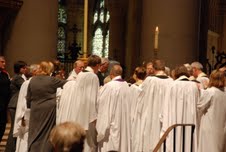
Photo: Laying on of hands, 2007.

Saturday, September 17, 2011

Daily Office Reflection: Do and Teach

Psalms 75, 76 * 23, 27; 2 Kings 2:1-18; 1 Cor 4:1-7; Matthew 5:17-20

There is an old adage Do as I say, not as I do. This is one of the attitudes about which Jesus was always arguing with the Pharisees and the scribes. They lived one way and asked others to live and do things they refused to do themselves. Jesus is making clear to those same folks today that although he appeared to be a radical change agent, what he was doing was living into God's laws, fulfilling God's laws. From the point of view of the power brokers of that time and place, Jesus was looked at as changing everything, when in fact he was just doing what they were supposed to have been doing all along. We're early on in the Gospel of Matthew, the really big changes come later on in the story.

Jesus says today that whoever does them (lives out the commandments) and teaches them will be called great in the kingdom of heaven. Do and teach Jesus is instructing us. Live into what Jesus teaches and than teach those precepts to others: spread the word by deed, action and teaching. It is easy to fall into habits that allow the old adage of telling people what to do and not do those same things ourselves become part of our daily routine.

Thoughtfully (and prayerfully) altering how we walk through this world is one of the take-aways from today's Gospel selection.
jfd+

Copyright 2011, The Rev. John F. Dwyer. All Rights Reserved.
Art: Wet Feet (in progress), 2010, jfd+

Friday, September 16, 2011

Daily Office Reflection: Saltiness and Lightness

Psalms 69:1-23(24-30)31-38 * 73; 2 Kings 1:2-17; 1 Cor 5:16-23; Matthew 5:12-16

We are in our second day of Matthew's blessings and woes....still in the blessings, which to many of us sound like woes. Jesus says we are blessed when we: are reviled, and persecuted, and have evil done against us for false reasons, and accused of terrible things because of Jesus' name. Woohoo, sounds like blessing, doesn't it. Jesus goes on to say that our reward comes later, like the persecuted prophets before us. He then goes on to say that we are to be the truth tellers to the world by being like salt, and like a bright light that cannot be extinguished.

Salt, when used correctly, can enhance and bring out flavors that would have remained hidden. In a similar manner, light takes away shadows, preventing things that might be hidden from staying that way. We are that salt that brings out the true nature of people, allows them to live into this kingdom Jesus has created for us. We are that light that can illuminate hidden places where the kingdom needs to be experienced by those living in those shadows.

As it was in Jesus' time, and through the centuries between now and then, this can be a dangerous and challenging way to interact in the world. Dangerous and challenging because we continue to be called to model a way of operating in the world that runs counter to how our culture, our society,trundles on. We need to point out that there are poor people, starving people, individuals treated incorrectly because of where they are from, or what they look like, or because they are "different" from "the norm". We are to be the salt that brings about awareness of those less fortunate and forgotten and mistreated by society. We are to turn the attention of society to these areas that need assistance and fair treatment and find ways to help those less fortunate.

Blessings, yes. Difficult, yes. As part of the Body of Christ, being salty and bringing light is who we are to be. The rewards are not only in heaven, they are seeing the change, no matter how small, wrought in the world by our saltiness and light.
jfd+

Copyright 2011, The Rev. John F. Dwyer. All Rights Reserved.
Art: Textured Cross, jfd+, 2009